Daily Technology
·17/03/2026



The concept of humanoid robots is rapidly moving from science fiction to practical reality. The primary challenge is no longer just building a machine that can walk, but enabling it to see, understand, and navigate our complex, dynamic world safely. Recent demonstrations, such as those at NVIDIA GTC, highlight the critical technological trends making this possible.
For humanoids to operate alongside people, they require a far more sophisticated environmental awareness than their wheeled counterparts. This is where dense 3D perception comes in. Using technologies like advanced depth cameras and Visual SLAM (Simultaneous Localization and Mapping), robots can build a detailed, three-dimensional map of their surroundings in real-time. This is not just about seeing obstacles; it's about understanding terrain, identifying edges, predicting the movement of people, and ensuring stable locomotion on uneven surfaces.
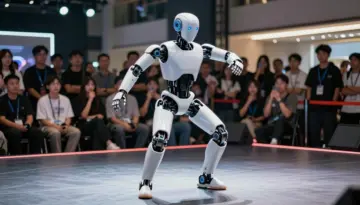
This technology is the foundation for responsible autonomy. For example, LimX Dynamics showcased a humanoid powered by RealSense depth cameras that could autonomously navigate a complex space. This system enables critical safety features like collision avoidance, fall prevention, and predictable, human-readable motion, moving robots beyond the confines of controlled environments.
Training a robot to handle the near-infinite variables of the real world is a monumental task. The industry is increasingly adopting a simulation-first approach to bridge this “sim-to-real” gap. By creating high-fidelity digital proving grounds, developers can train a robot’s AI through reinforcement learning in a virtual space. This allows the machine to master complex maneuvers and safety protocols in a fraction of the time and at a fraction of the cost of physical-only training.
This method was instrumental in accelerating the development of the LimX Dynamics humanoid. The team used NVIDIA Isaac Lab, a robotics simulation platform, to train and validate the robot's navigation and locomotion policies. This ensured the machine could perform with predictable safety before its physical debut, proving the viability of virtual training for real-world deployment.
Advanced perception is more than just raw sensor data; it requires an integrated system that functions as the robot's visual cortex. This trend involves fusing hardware, like depth cameras, with powerful reasoning software to enable true scene understanding. The goal is to give the robot the ability to accurately know where it is, what is around it, and how to adapt its path in response to changing conditions.
The collaboration between RealSense and NVIDIA exemplifies this trend. By integrating RealSense’s dense depth perception with NVIDIA's visual odometry technology (cuVSLAM), the system provides the humanoid with the comprehensive awareness needed for safe operation in 3D space. This fusion unlocks new capabilities, such as navigating stairs, traversing uneven ground, and dynamically avoiding moving obstacles, which have historically been difficult to execute safely.