Daily Technology
·20/03/2026



Nvidia's GTC 2026 conference buzzed with innovation as Techman Robot unveiled its groundbreaking TM Xplore I, a humanoid robot designed to revolutionize industrial automation. This advanced machine, powered by cutting-edge AI, demonstrated capabilities that promise to reshape factory floors and collaborative work environments.
Techman Robot made a significant impact at Nvidia's GTC 2026 by introducing the TM Xplore I, a next-generation humanoid robot poised to redefine industrial automation. This innovative machine embodies Techman's "See · Think · Act — Powered by AI Robotics" brand direction, focusing on the seamless integration of perception, reasoning, and action.
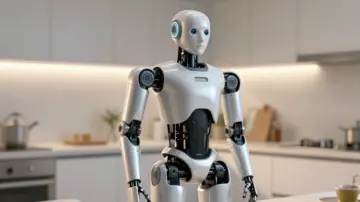
The TM Xplore I features a distinctive design, combining a human-like upper body with a stable, wheeled base. This configuration is engineered to provide superior stability and flexibility, making it well-suited for dynamic factory environments. During its demonstration, the robot actively interacted with attendees, even delivering items to designated locations, offering a tangible preview of how such robots can work alongside human counterparts.
At the core of the TM Xplore I's intelligence is NVIDIA's Jetson Thor computing module. This powerful platform enables the robot to perform high-level AI tasks directly at the edge, allowing it to adapt to new assignments dynamically without the need for extensive reprogramming – a significant advantage over traditional industrial robots.
The robot's capabilities are further enhanced by its Vision-Language-Action (VLA) model. This allows the TM Xplore I to interpret visual information, understand verbal or written instructions, and make real-time decisions to execute complex tasks. These include intricate processes in semiconductor manufacturing, electronics assembly, and automotive production, all performed with a high degree of autonomy.
To ensure reliability and efficiency, Techman Robot is heavily utilizing simulation tools like NVIDIA Isaac Sim and FoundationStereo. These platforms enable the robots to undergo extensive training in virtual environments before being deployed in the physical world, significantly reducing development time and potential errors.
Techman Robot's technological advancements are backed by solid business performance. The company recently reported a substantial after-tax profit, marking a significant year-on-year increase, largely fueled by the growing demand for robot hardware and integrated software solutions in the expanding smart manufacturing sector.
The company is actively pursuing commercialization of its wheeled humanoid robots and plans to file for patents this year. Furthermore, Techman's robotic arms are already being deployed in critical industrial applications, such as welding large vessels for Taiwan's China Shipbuilding.
Techman's entry into the humanoid robotics space places it among a growing cohort of companies, including Tesla, Figure AI, and Agility Robotics, all striving to introduce general-purpose robots into real-world operational settings. The industry is rapidly transitioning from experimental prototypes to deployable machines, signaling a fundamental shift in how businesses approach automation.
What distinguishes this new generation of robots is their advanced AI integration, enabling adaptability rather than mere execution of pre-programmed routines. By merging vision, language comprehension, and physical action, robots like the TM Xplore I represent a move towards more versatile, multi-functional machines capable of working collaboratively with humans with minimal supervision.
As industries grapple with persistent labor shortages and escalating production demands, humanoid and semi-humanoid robots are increasingly positioned as essential collaborative tools, set to reshape the future of industrial work.