Daily Technology
·02/01/2026



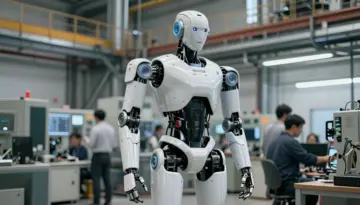
The push for humanoid robots with human-like movement is accelerating, with agility now a benchmark for industry advancement. The PHYBOT M1 leads this charge with technical feats captured on video, such as somersaults and inverted spins, making a statement that goes beyond showmanship. Generating over 10 kilowatts of instantaneous power, the M1’s uniquely high torque (up to 530 N-m in its joints) enables it to take off from a static position and land precisely, rivaling established models like Boston Dynamics’ Atlas.
This surge in performance is crucial for unlocking real-world applications in environments requiring rapid, adaptive movement—such as disaster response, warehouse logistics, and even entertainment. Boston Dynamics’ Atlas and Tesla’s Optimus continue to set high bars for agility, but M1’s power-driven approach signals a new direction for robotics benchmarks.
Cutting-edge robots increasingly depend on sophisticated perception technologies for spatial awareness and stability. The PHYBOT M1 employs an array of sensors, including 3D LiDAR, stereo cameras, and IMUs (Inertial Measurement Units), delivering high-level spatial perception and ensuring balance during complex maneuvers.
These sensing capabilities have practical implications: they empower robots to adapt to unpredictable, human-centric environments. For example, M1’s balanced acrobatics demonstrate immediate applicability in workplaces where robots must navigate cluttered or changing spaces. This trend aligns with industry developments such as the use of LiDAR in autonomous vehicles and advanced industrial automation.
Unlike many industry players relying on open-source frameworks, PHYBOT distinguishes itself with a fully proprietary control system. Its architecture fuses Nvidia’s Jetson Orin chip with an Intel Core i7 processor, enabling real-time data processing and faster adaptations to complex tasks.
In-house development underlines the move toward technological independence in robotics, reducing reliance on third-party solutions and allowing tailored optimizations. This mirrors a broader industry trend, particularly among Chinese robotics startups, and is reflected in companies like Unitree Robotics, who are developing tailored algorithms for their hardware.
A major leap in recent robotics is optimizing the power-to-weight ratio. The PHYBOT M1, standing 172 cm tall and under 60 kg, boasts a torque density of 200 N-m/kg—one of the best in the market. This ratio means more physical work per kilogram, enhancing utility in both industrial and research settings.
Previously, robots often traded off strength for mobility. M1's blend of explosive power and relatively light frame enables it to carry objects up to 20 kg with its arms and transport more than 50 kg using a modular backpack. These capabilities make robots increasingly viable for physically demanding tasks, pushing the market’s competitive edge.
Humanoid robots are transcending the role of research prototypes or demonstrators. PHYBOT M1 is designed for up to two hours of autonomy, capable of handling substantial labor—moving objects and supporting industrial workflows.
This shift is mirrored by Tesla’s Optimus, targeting manufacturing environments, and Boston Dynamics’ continuous expansion into utility-driven deployments. The focus is on productivity and real-world ROI, with companies vying to make robots essential in settings ranging from labs to factories.
The launch of PHYBOT M1 exemplifies critical trends for 2024: explosive robotic power, advanced perception, proprietary architectures, enhanced power/weight ratios, and an unmistakable move from demos to functional tools. With a targeted price below $42,000, M1 also signals increased accessibility, stoking competition across global robotics players.