Daily Technology
·21/04/2026



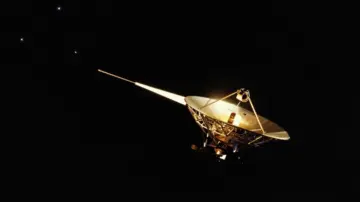
NASA engineers have made the difficult decision to deactivate one of Voyager 1's science instruments due to an unexpected drop in the spacecraft's power levels. This measure is part of an ongoing effort to extend the life of the venerable probe as it continues its historic journey through interstellar space, now operating with only two of its original ten instruments.
In late February, Voyager 1 experienced a concerning dip in its power supply during a routine roll maneuver. To prevent the spacecraft's safeguard system from automatically shutting down components, mission managers at NASA's Jet Propulsion Laboratory (JPL) opted to proactively disable one of its science instruments. This decision, while not ideal, is seen as the best available option to keep the spacecraft operational.
Voyager 1, powered by the heat from decaying plutonium, loses approximately 4 watts of power annually. To counteract this gradual decline and prolong the mission, engineers have been systematically turning off non-essential systems, including several science instruments.
The Low-energy Charged Particles experiment, or LECP, was the next instrument on the list for deactivation. For 49 years, LECP has been crucial in measuring low-energy charged particles like ions, electrons, and cosmic rays, providing vital data on the structure of the interstellar medium. On April 17, commands were sent to shut down LECP, a process that took approximately 23 hours to reach the spacecraft and another three hours and 15 minutes to complete.
Launched in 1977, Voyager 1 has far surpassed its original five-year mission objective, becoming the farthest human-made object from Earth at a distance of 15 billion miles. The twin Voyager probes continue to operate nearly 50 years later, a testament to their robust design and the ingenuity of NASA engineers.
The shutdown of LECP is expected to provide about a year of additional operational time, allowing engineers to finalize a more comprehensive energy-saving solution known as "the Big Bang." This ambitious plan involves replacing power-hungry devices with lower-power alternatives to maintain sufficient warmth for data collection and further extend operations in interstellar space.
While one part of LECP, a small motor, was kept active in the hope of future reactivation, Voyager 1's remaining operational science instruments include a plasma wave sensor and a magnetic field detector. These instruments continue to send back valuable data from unexplored regions of space, underscoring the team's commitment to keeping both Voyager probes active for as long as possible.