Daily Technology
·08/04/2026



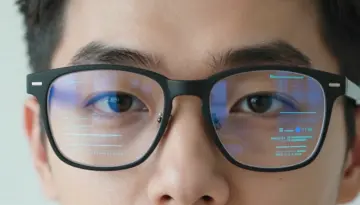
Everysight has launched the Maverick AI Pro, the world's first smart glasses featuring integrated eye-tracking technology. While promising a revolutionary new input method for augmented reality, the initial release is described as intriguing yet unpolished, facing challenges in user experience and design.
Smart glasses have long grappled with intuitive control methods. While wristbands, touchpads, and voice commands have been explored, Everysight's Maverick AI Pro introduces eye-tracking as a potential "Holy Grail" of inputs. This technology, similar to that found in devices like the Apple Vision Pro, allows users to navigate menus and select applications simply by looking at them.
The Maverick AI Pro glasses are remarkably lightweight, weighing just 47g, significantly less than some competitors. This is partly due to their innovative display technology, which projects directly onto the lens rather than using traditional waveguides. This method not only reduces weight but also enhances battery efficiency, offering approximately nine hours of use.
The display itself is impressive, with a peak brightness of 5,000 nits and a resolution of 1,280 x 720, surpassing some existing smart glasses in clarity and brightness. Users can also adjust the display's position on the lens, offering more flexibility than fixed-position displays.
Setting up eye-tracking is straightforward, involving a quick calibration process of five to eight seconds. When it works correctly, users can select items by focusing their gaze on them until they are "selected." However, the system is temperamental. Small adjustments to how the glasses sit on the face can disrupt calibration, requiring recalibration. This sensitivity presents a significant hurdle for a seamless user experience.
Another challenge is the visibility of the technology. The eye-tracking and projection modules are noticeable from the outside, which may detract from the desired aesthetic of smart glasses that blend in with regular eyewear. Everysight is reportedly working on solutions to make these components less conspicuous.
While the Maverick AI Pro showcases promising technology, particularly its eye-tracking and projection systems, it is still in its early stages. The company acknowledges the need for refinement in calibration and user interface design. The broader adoption of eye-tracking in smart glasses will depend on overcoming these usability issues and addressing privacy concerns that continue to surround wearable cameras. Everysight aims to provide its technology as a platform for other manufacturers, suggesting a future where this innovative input method could become more widespread, even if the initial product is a work in progress.