Daily Technology
·07/04/2026



The landscape of industrial automation is undergoing a seismic shift. For decades, robotics was synonymous with large, caged arms performing repetitive tasks with precision. Today, a new era is dawning, driven by artificial intelligence and the rise of "physical AI," fundamentally redefining what a robot can do on the factory floor.
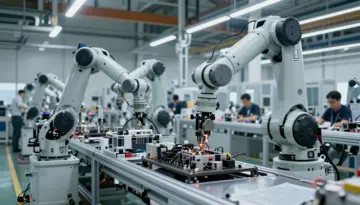
Traditional industrial robots have long been the backbone of modern manufacturing. These systems operate based on fixed programming, executing a predefined sequence of motions with incredible speed and repeatability. Their strength lies in structured environments where the task never varies, such as welding car bodies or placing components on a circuit board. However, their lack of sensory perception and inability to adapt makes them unsuitable for dynamic settings or tasks with even minor variations.
In contrast, the new generation of robots, including advanced humanoid models, operates on the principle of physical intelligence. By integrating advanced sensing, edge computing, and sophisticated AI models, these machines can perceive their surroundings, make decisions in real time, and adapt to changing conditions. This allows them to work in environments designed for humans, use standard tools, and handle tasks that were previously impossible to automate, such as complex assembly or material handling in a busy warehouse.
The performance metrics for these two classes of robots differ significantly. While a traditional robot is measured by its speed and cycle time for a single task, an AI-powered robot is valued for its flexibility and problem-solving capabilities. This transition is also reshaping the human workforce. Instead of simply replacing labor, intelligent robots are becoming collaborative partners. They handle physically demanding or precision-intensive work, freeing human workers to focus on higher-level responsibilities like process oversight, quality control, and managing the robotic systems themselves.
This evolution is not theoretical. Major automotive manufacturers are already testing humanoid robots to perform assembly tasks alongside human workers. In logistics, proof-of-concept deployments, such as one at a Siemens facility, have shown humanoids autonomously managing material transport within a live production workflow. This stands in stark contrast to the isolated work cells required by their predecessors.
The divergence is clear: robotics is moving from isolated automation to integrated, intelligent systems. The focus has shifted from replacing a single task to augmenting entire production processes. As these adaptable, intelligent machines become more common, the question for manufacturers is no longer about whether to automate, but how to integrate this new physical intelligence across the entire factory floor.