Daily Technology
·18/03/2026



The recent buzz at major tech shows like CES and IFA suggests a future filled with humanoid robots performing our daily chores. While the vision of a robot cooking dinner is compelling, the immediate future of kitchen automation is taking a different, more practical shape. The revolution isn't walking on two legs—it's sitting on your countertop.
Instead of general-purpose humanoids, the most significant near-term trend is the emergence of sophisticated countertop cooking robots. These devices are an evolution of multifunction cookers like the Thermomix, but with a crucial difference: full autonomy. They are designed to handle entire multi-step recipes without human intervention, from dispensing ingredients to transitioning between cooking methods. This addresses the daily burden of meal preparation in a contained, familiar appliance form factor.
Leading this charge are companies like Posha and Nosh. Posha’s CEO describes their device as the “Waymo equivalent of driving,” a fully autonomous system compared to the driver-assist nature of older appliances. Similarly, Nosh, which successfully funded its first-generation robot on Kickstarter, markets its system as a “kitchen in a box” that automates not just timing and heat, but the complex judgment calls involved in cooking.
Underpinning the advance of all robotics is the massive effort to build comprehensive datasets for AI training. Much like training models in the 2010s enabled today's autonomous vehicles, companies are now scaling the capture of real-world physical interaction data. This information is essential for teaching robots how to move and operate effectively in unstructured environments like a home.
This trend is exemplified by efforts like Instawork, which equips temporary workers with bodycams to record them performing everyday tasks. This modern approach builds on earlier academic projects like EPIC Kitchens, which began capturing video of physical interactions in 2018 to train computer vision systems. The massive funding flowing into the AI and robotics space is accelerating this data collection by orders of magnitude, paving the way for more capable machines.
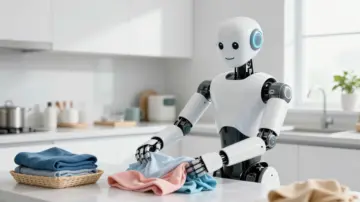
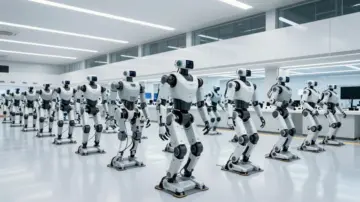
While not yet ready for complex kitchen tasks, humanoid robots are still a critical long-term trend, particularly for accessibility. Early models like the NEO 1 are still largely teleoperated—controlled by a remote human—and geared toward early adopters. However, as their autonomy and capabilities improve, they hold immense potential to become indispensable companions for individuals with mobility or dexterity challenges.
For aging populations or those who struggle with independent living, a humanoid assistant that can reliably handle household chores, including cooking, could be transformative. The high cost of managed care makes this an area of significant future impact. For now, they remain a future vision, but one that is steadily moving closer to reality as the underlying AI and hardware mature.