Daily Technology
·16/03/2026



Humanoid robots are rapidly transitioning from research concepts to tangible products, poised to enter our factories, businesses, and even homes. This evolution is not happening by chance; it's driven by several key technological and economic trends that are shaping their development. Understanding these core advancements is crucial for tracking the future of automation and artificial intelligence.
A significant trend is the shift from highly specialized industrial robots to general-purpose humanoids. While traditional robots excel at a single, repetitive task on an assembly line, the new generation aims for adaptability. The goal is to create machines that can perform a wide range of duties in environments designed for humans.
This is exemplified by Tesla's Optimus robot, which is beginning its journey in automotive manufacturing but is ultimately envisioned for much broader applications. Similarly, companies like 1X Technologies are developing humanoids such as Neo with the explicit purpose of assisting with household chores, representing a move toward versatile, everyday utility.
While stable bipedal locomotion is becoming a standard capability, the next major hurdle is dexterous manipulation. Developers are moving beyond simple two- or three-fingered grippers to create hands that can replicate human dexterity. This involves not only complex mechanics but also advanced tactile sensing to handle delicate or irregularly shaped objects.
This pursuit is complex and costly. The actuators required for precise finger movements are difficult to maintain, and soft fingertips needed for sensing can wear out quickly. The ability for a robot to not just hold a tool but use it with skill is the next frontier that will unlock more advanced applications.
Modern robotics development is increasingly reliant on AI and simulation for training. Instead of manually programming every joint movement, developers now break down a complex task into sub-goals and use powerful simulations to run through the task hundreds of thousands of times. This allows the AI to discover the most efficient and successful combinations of movements on its own.
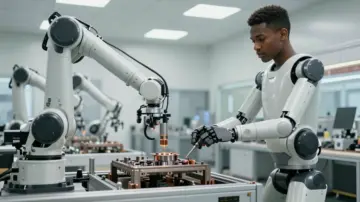
This method, which includes techniques like reinforcement learning, is how robots like the Unitree G1 are being taught new skills. It accelerates the learning process, enabling robots to master activities that would be prohibitively time-consuming to program by hand, from serving drinks to performing quality control.
For humanoid robots to become widespread, they must be economically viable. A critical industry focus is on reducing their price to a level comparable to a family car, with many companies targeting a range of $20,000 to $50,000. This price point is seen as the threshold for mass-market adoption in both commercial and consumer settings.
This economic goal, publicly stated by figures like Elon Musk for Tesla's Optimus, is a powerful driver of innovation in manufacturing and component design. Achieving affordability will be just as important as technological capability in determining whether humanoids become a common sight or remain a niche product.