Daily Technology
·16/02/2026



The field of humanoid robotics is witnessing rapid advancements, with various models showcasing distinct engineering philosophies. Among the notable contenders are the Robotera L7 and the Unitree G1. An objective comparison of their core specifications reveals different approaches to mobility, dexterity, and potential real-world application.
The Robotera L7 is a full-sized humanoid, standing 171 cm tall and weighing 65 kg. Its construction utilizes premium materials like titanium and carbon fiber, contributing to a lightweight yet robust frame. In contrast, the Unitree G1 is designed for compactness. It has a standing height of 127 cm and a weight of approximately 35 kg. A significant feature of the G1 is its ability to fold down to a height of just 69 cm, highlighting a design focus on portability and storage.
A critical differentiator between the two robots is their mechanical freedom. The L7 features a total of 55 degrees of freedom (DoF). This includes highly articulated arms with 7 DoF each and hands that possess a combined 12 DoF, allowing for delicate and precise manipulation. The Unitree G1 is equipped with 23 total DoF, allocated as 5 DoF per arm, 6 per leg, and 1 in the waist. This fundamental difference in joint complexity directly correlates to their respective capabilities for performing intricate movements.
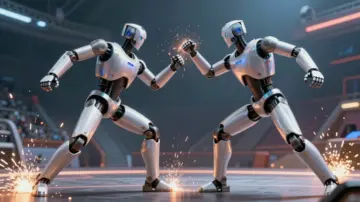
The L7's advanced articulation enables it to perform highly dynamic and complex tasks, as seen in demonstrations involving sword dancing and breakdancing. These activities require superior balance, coordination, and fluid motion control. The robot can also achieve a top speed of 4 m/s, suiting it for logistics or service roles. The Unitree G1's specifications, such as a maximum knee torque of 90 N.m and a 2 kg arm load capacity, point toward a focus on stability and functional strength within a smaller form factor.
In conclusion, the Robotera L7 and Unitree G1 represent two divergent paths in humanoid robot development. The L7 is engineered as a larger, highly agile platform capable of replicating nuanced human motion for dynamic tasks. The G1 offers a smaller, lighter, and more portable solution, prioritizing fundamental mobility and strength. Both designs underscore the varied strategies being employed to integrate advanced robotics into practical applications.