Daily Car
·21/04/2026



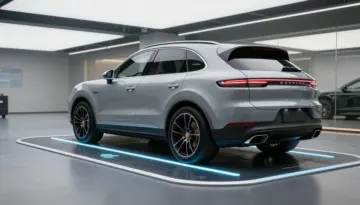
It is an inductive charging system scheduled to debut on the 2026 Porsche Cayenne Electric. This technology eliminates the need for physical charging cables. The driver parks the vehicle over a charging plate installed on a garage or driveway floor, and the battery begins to charge automatically after a digital verification process.
The system operates on the principle of magnetic induction, which is the same technology used in wireless smartphone chargers and induction cooktops. A base plate connected to a household power supply contains a transmitter coil. This coil generates a magnetic field that transfers energy across an air gap of 12-18 cm to a receiver coil installed on the underside of the Cayenne. This alternating current (AC) is then converted to direct current (DC) to be stored in the vehicle's battery.
The system is designed to deliver up to 11 kilowatts (kW) of power, which is on par with the speed of a typical Level 2 wallbox charger commonly installed by EV owners. Porsche claims an efficiency rate of 90%, indicating minimal energy loss during the wireless transfer. It is important to note that in certain regions, like the UK, the power output will be limited to the local grid's rating, such as 7.6kW.
To ensure proper operation, the vehicle's central display provides a visual guide, helping the driver accurately position the car over the charging plate. For safety, the system is equipped with sensors that detect foreign objects. If an animal or item enters the magnetic field, the charging process is immediately halted. The unit is also fully waterproof and meets all relevant safety regulations for electromagnetic compatibility.
This advanced feature is an optional extra and carries a significant price. The estimated total cost is approximately £6750. This figure comprises the ground plate (around £4750), the vehicle's receiver unit (around £1700), and the necessary wiring preparation. While the initial investment is high, prices are expected to decline if the technology gains wider adoption and achieves economies of scale.