Daily Car
·18/03/2026



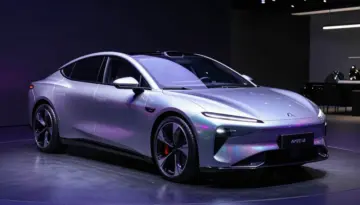
As Tesla shifts its focus, California electric vehicle startups Lucid and Rivian are stepping up to fill the void in the mass-market crossover segment. With the Rivian R2 set to launch this spring and Lucid's Cosmos aiming for production by year-end, both vehicles are targeting the popular Tesla Model Y. While the R2 has revealed more details, emerging information about the Lucid Cosmos suggests it may hold a technological advantage in charging speed and efficiency.
Lucid's upcoming Cosmos will benefit from an 800-volt battery architecture, a significant upgrade that allows it to add an estimated 200 miles of range in just 14 minutes of charging. This technology positions the Cosmos among the fastest-charging EVs available, comparable to Lucid's own Gravity model. The 800-volt system requires less current to achieve higher charging speeds, making the process more efficient.
In contrast, the Rivian R2 utilizes a 450-volt architecture. While Rivian has confirmed this choice, CEO RJ Scaringe has indicated a focus on energy density and cost-effectiveness with its nickel-based battery chemistry, rather than prioritizing extreme charging speeds. The R2 boasts a claimed 10-80% charge time of 29 minutes, adding approximately 150 miles of range in about 15 minutes, which is competitive with the Tesla Model Y. However, the Cosmos is anticipated to offer a more substantial gain in miles per minute during charging stops.
Lucid is projecting significant efficiency gains for the Cosmos, attributed to its aerodynamic design and advanced motor engineering. With a projected drag coefficient of just 0.22, the Cosmos is expected to be considerably more aerodynamic than the R2. Furthermore, Lucid's new Atlas drive unit is designed with 30% fewer parts, is 23% lighter, and offers 40% greater power density compared to the Model Y's drive unit.
These advancements lead Lucid to project an impressive efficiency of up to 4.5 miles per kilowatt-hour (kWh) for the Cosmos. This figure surpasses the typical efficiency range of 2.5 to 4.0 miles per kWh seen in most current EVs. This high efficiency means Lucid anticipates needing only around 69 kWh of battery capacity to achieve 300 miles of range.
For comparison, the Rivian R2 Standard model is estimated to achieve 345 miles of range from an 87.9 kWh battery, translating to an on-paper efficiency of about 3.9 miles per kWh. Higher efficiency not only contributes to faster charging due to smaller battery packs but also reduces running costs for consumers. For Lucid, efficiency is also a strategic advantage, potentially lowering battery material costs without compromising performance.