Daily Technology
·27/04/2026



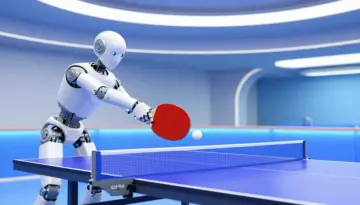
The frontier of artificial intelligence is rapidly expanding from digital realms into complex physical interaction. A recent breakthrough from Sony AI demonstrates this shift, showcasing a robot arm named Ace that can compete with and defeat elite human table tennis players. This development is not just a sporting achievement; it signals significant progress in robotics, machine learning, and real-time control systems.
This advancement is built on several key technological trends that are converging to create more capable and interactive machines.
For the first time, a robot has achieved expert-level performance in a competitive physical sport under official rules. Sony's Ace robot has successfully won matches against elite players with over a decade of experience and even some top-level professionals. This milestone moves beyond simple programmed movements, showcasing an AI's ability to strategize and react in a dynamic, high-speed environment. The project serves as a powerful real-world case study for applying AI to tasks requiring nuanced physical skill and rapid decision-making.
The robot's performance is enabled by a sophisticated perception system. Using nine cameras and three vision systems, Ace can track the ball's position at 200 Hz with millimeter accuracy and a latency of around ten milliseconds. It can also measure the ball's spin at up to 700 Hz, capturing motion that is a blur to the human eye. This level of sensory precision and processing speed is critical for reacting to aggressive, professional-level shots and is a major leap forward for real-time robotic control.
Ace's ability to play strategically stems from deep reinforcement learning. This AI technique allows the system to predict the ball's behavior and choose the optimal way to counter its opponent. Instead of relying on pre-programmed responses, the robot learns and adapts. This makes it an incredibly challenging opponent, as human players find it nearly impossible to sense what types of shots it struggles with, a common strategy used against human adversaries.
While mastering ping pong is impressive, the underlying technologies have far-reaching implications. The project's leaders at Sony AI note that similar techniques in perception and learning-based control could be applied to other fields. Potential applications include advanced manufacturing, service robotics, entertainment, and safety-critical physical domains where fast, precise interaction with the real world is essential. Ace is not just a game-player; it's a prototype for the next generation of intelligent, interactive robotics.