Daily Technology
·22/04/2026



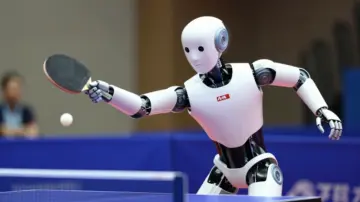
At a major industrial trade fair in Germany, AI-powered robots demonstrated their "physical AI" skills, showcasing a potential technological leap for the nation's manufacturing sector. This development is seen as a crucial opportunity for Europe to compete with the United States and China in the artificial intelligence race, particularly by integrating advanced AI into existing industrial processes.
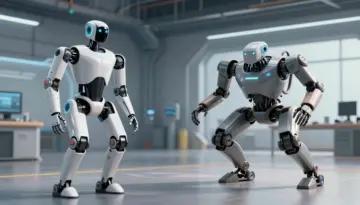
A blue-eyed humanoid robot, developed by German startup Agile Robots, captivated visitors by demonstrating its ability to perform intricate tasks like opening a box and placing a tool inside. This "physical AI" was a highlight at the Hanover fair, the world's largest industrial technology event. Agile Robots plans to begin equipping German factories, especially in the automotive industry, with these advanced robots starting next year.
Chancellor Friedrich Merz visited the Agile Robots stand, expressing strong support for encouraging German manufacturers to adopt AI. He emphasized that AI should be integrated into the core sectors of the economy, particularly benefiting small and medium-sized enterprises, to generate industrial added value and secure high-quality employment.
Despite Germany's efforts, the country is playing catch-up with China in the development of humanoid robots. Chancellor Merz had previously witnessed China's advancements firsthand, observing robots performing complex physical feats. Chinese manufacturers, including Unitree, were also prominent at the Hanover fair, showcasing their capabilities.
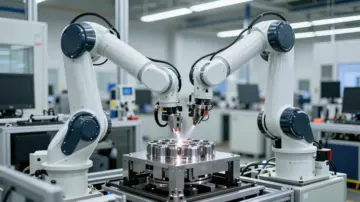
However, Rory Sexton, CEO of Agile Robots, remains optimistic, stating that German companies will soon match Chinese capabilities. He stressed that Agile Robots' focus is on practical, value-added industrial tasks such as electronic wiring and assembly, rather than purely demonstrative performances. Sexton highlighted Germany's advantage in its robust "ecosystem of suppliers" and its deep expertise in mechanical engineering and automation, which are vital for AI development.
Surveys indicate that a significant majority of German industrial firms believe humanoid robots can help address skilled labor shortages. Furthermore, Germany possesses vast amounts of industrial data from its factories, which Antonio Krueger, head of the German Research Centre for Artificial Intelligence (DFKI), considers to be of superior quality compared to that of the US or China. This data is a critical asset for training and improving AI systems.
Despite these advantages, critics point out that the use of this data is often fragmented and lacks a unified strategy. Not all industry players are convinced that AI is a panacea for the challenges facing German manufacturers, such as high energy costs and weak demand. Jochen Heinz, an executive from SW Machines, cautioned about the potential "dark side" of AI, citing instances where AI might provide incorrect instructions or false problem detections, underscoring the need for careful implementation and oversight.